Blackjack Shuffle Mechanics: How Dealer Techniques Shape Card Distribution Probabilities
Written by Cameron Lehmann · Aug 16, 2026
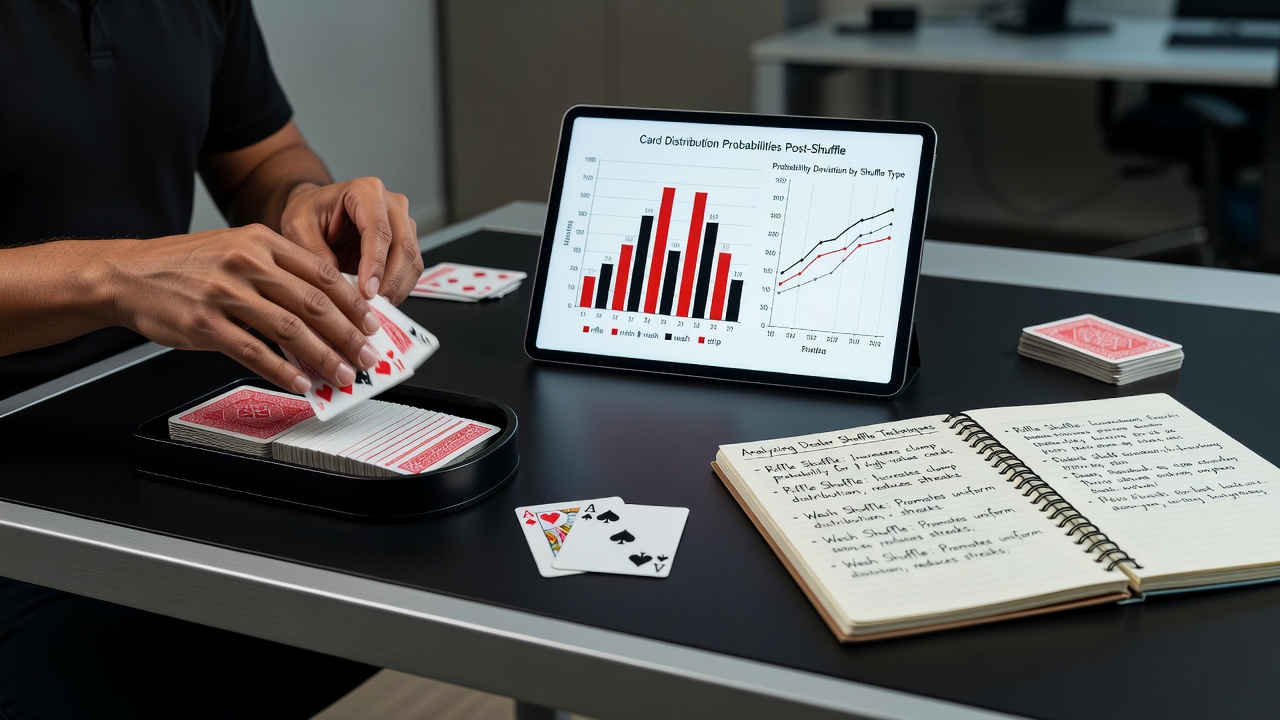
Blackjack Shuffle Mechanics: How Dealer Techniques Shape Card Distribution Probabilities
Blackjack tables rely on shuffle procedures that determine how cards move from one round to the next, and those procedures directly affect the probability structure of the remaining deck. Researchers have examined manual techniques such as the riffle shuffle, the strip shuffle, and the wash, along with automated continuous shufflers, to measure how each method redistributes card order. Data from controlled trials show that even small variations in shuffle execution change the likelihood of high or low cards appearing in specific positions during subsequent hands.
Core Shuffle Techniques Used in Casinos
Dealers typically combine several actions during a manual shuffle. The riffle shuffle splits the deck into two halves and interleaves them, while the strip shuffle pulls sections from the middle and restacks them. A wash involves spreading cards face down across the table and mixing them with circular hand motions. Each step leaves measurable patterns when performed by hand; for instance, repeated riffles often preserve clusters of cards that started close together. Automated machines, by contrast, use rotating drums or randomizing wheels that repeat a fixed sequence of movements, and independent tests indicate these devices achieve closer approximations to uniform distribution than most manual methods.
Measuring Effects on Card Distribution
Probability models track the position of every card after a given number of shuffles. Mathematicians apply the Gilbert-Shannon-Reeds model to riffle shuffles and calculate the number of repetitions needed to bring the deck within a set distance of randomness. Laboratory observations reveal that seven riffle shuffles bring a 52-card deck near equilibrium, yet casino procedures often use fewer passes when multiple decks are in play. As a result, residual correlations persist between consecutive cards, altering the chance that a ten-value card follows another ten-value card in the next round. Studies published by university gaming laboratories document how these correlations shift expected values for both players and the house when basic strategy tables assume perfect randomness.
Impact on Blackjack-Specific Probabilities
In multi-deck games the effect compounds because dealers shuffle larger packs. When a shuffle leaves low cards clumped near the top, the dealer draws more bust hands early in the shoe, which changes the frequency of player blackjacks and dealer upcard combinations. Data collected from surveillance recordings at several Nevada properties indicate that shoes shuffled with fewer than five riffle passes produce measurable deviations in the distribution of aces and tens within the first third of the deck. Continuous shuffle machines eliminate this progression by reinserting discards after every hand, and regulatory reports from the Nevada Gaming Control Board confirm that approved devices maintain statistical randomness within defined tolerances across thousands of cycles.
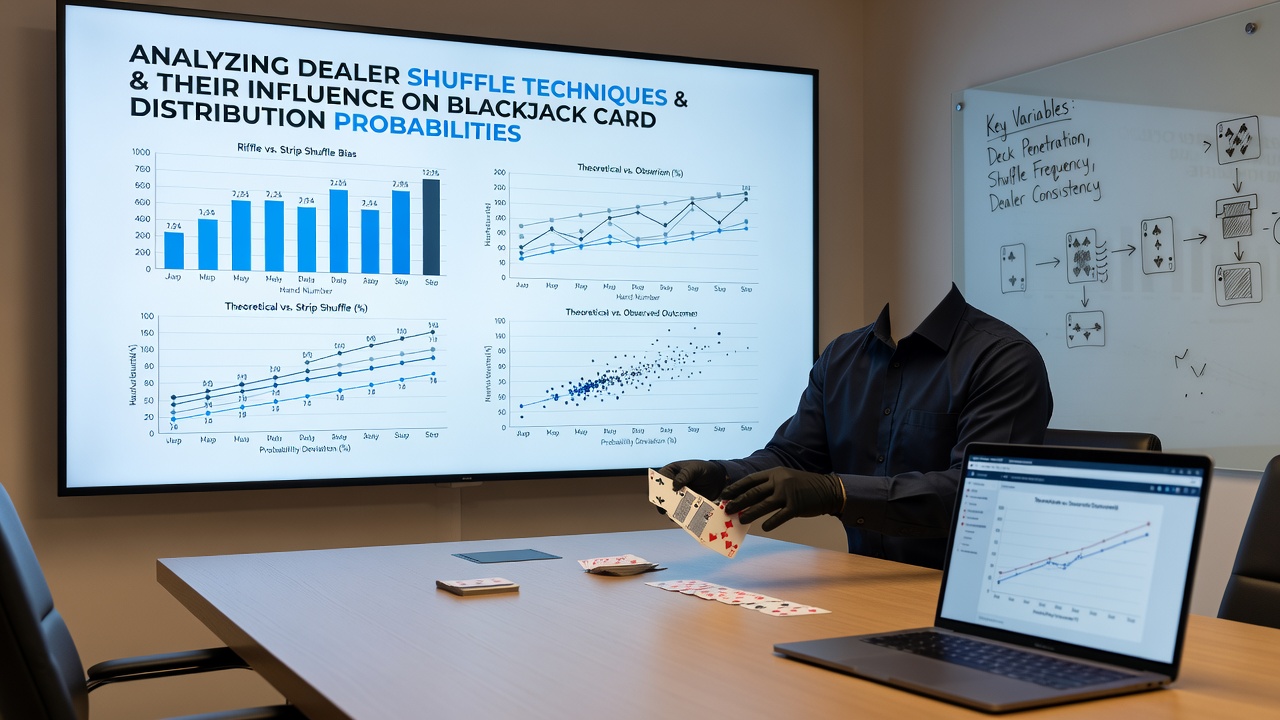
Regulatory Standards and Testing Protocols
Gaming authorities require independent laboratories to certify shuffle equipment before deployment. The Australian Communications and Media Authority, for example, sets performance criteria that include minimum entropy thresholds and resistance to predictable sequences. Manufacturers submit machines for evaluation, and test results must demonstrate that card sequences pass chi-square and runs tests at specified confidence levels. When a new continuous shuffler model enters the market, regulators compare its output against historical manual shuffle data to verify that the automated distribution does not create exploitable biases. These certification steps occur on a recurring schedule, with additional audits triggered after any hardware modification.
Research Findings on Real-World Play
Long-term tracking studies at Canadian casinos have compared shoes dealt from manually shuffled decks against those from continuous machines. Results show that manual shuffles produce slightly higher variance in the number of tens appearing in the first twenty hands, while continuous machines keep that count closer to the theoretical mean. Observers note that these differences remain small in absolute terms yet accumulate across thousands of decisions per table. University researchers have also modeled the interaction between shuffle quality and penetration depth, demonstrating that deeper penetration amplifies any non-random patterns left by the shuffle. Reports from the Centre for Gambling Research at the University of Sydney further indicate that player decisions based on counting systems lose edge when continuous shufflers reset the deck after every round.
Conclusion
Shuffle technique remains a measurable variable in blackjack probability calculations. Manual methods introduce limited but detectable correlations, while certified automatic devices reduce those correlations to levels consistent with regulatory standards. Ongoing laboratory testing and field data collection continue to refine the understanding of how each procedure influences card distribution across different game formats and deck sizes.